Tuesday, February 12, 2013

Movie Review: The Hobbit - An Unexpected Journey

Is it a good idea to take The Hobbit, a relatively simple story for children contained in a single, not especially thick book, and then to spin it into three epic, connecting movies? The answer from an economic perspective is, of course, “yes”. After all, the three movies will form a prequel to the hugely successful Lord of the Rings trilogy. It means three tickets sold per viewer by the end of it all, instead of two. (To just make one (1) movie out of one (1) book would be madness. And more importantly, bad for business.) That’s not to say I believe returning director Peter Jackson had dollar signs for eyes when he decided to make it a trilogy again, just that he was over-indulged by a movie studio with less than artistic motives.

The Lord of the Rings was basically about a hobbit bringing a ring to a volcano to save the world. The Hobbit is about a related hobbit originally finding that ring and helping some dwarves reclaim their homeland by taking on a dragon. The Hobbit (or there and back again) was written by Tolkien as a children’s story, though he was consciously laying the foundation for something more, while The Lord of the Rings was a full-fledged attempt to create a new mythology for England, and was aimed primarily at adults. (To Tolkien’s horror, it ended up having the most impact on hippies and stoners at the time of publication.) Not surprisingly, considering the source, there is a different, more playful tone to Peter Jackson’s newest outing into Middle-Earth. While there was already some silliness to the first trilogy, here it is more prominent and it doesn’t quite track with other scenes that are deadly sincere. There is a delicate balance when getting people on board for a story about goblins, elves, trolls and the like. You want them to take it seriously, but most people will need an occasional wink to acknowledge that you are asking them to take a large leap of faith. This time around, there are a few too many ‘yeah, right’ moments in the recipe, that we’re expected to take at face-value.

Not helping matters is that real danger seems to be lacking. The group of heroes at the center of the story go from one deadly situation to the next and emerge pretty much unscathed. Tension starts to drain away with each unlikely victory. Gandalf makes things worse, and you understand why Tolkien sidelined him for large parts of The Lord of the Rings. While I love Ian McKellen for both his acting and his work as a gay rights activist, his wizard character serves as a Deus Ex Machina too often. He is powerful, though his powers are ill-defined, and he can always save the day in a seemingly hopeless situation. (Though, oddly, not before it has actually started to seem hopeless.) Despite feeling too ‘safe’, the movie is not really for kids, as there is a fair amount of graphic violence.

A lot of extra content has been added to the original tale and back-story has been added, delving into Tolkien’s mythology. This doesn’t disguise the fact that the main narrative is being stretched to near the breaking point. Lots of exciting things happen to the heroes, but large chunks of the movie could have been removed without impacting the rest of the story. One thing happens after the other, and it doesn’t feel like all of it is intricately connected. Admittedly, spending time in this beautiful-looking realm again is fun regardless, as is meeting up with characters from the original trilogy. All the actors are game, joyously throwing themselves into their roles, and Martin Freeman is perfect as Bilbo. But forward momentum is missing, and though the end goal is noble, the stakes are not on par with those from the previous trilogy. The element of surprise is gone and it all feels very familiar. There are only so many sweeping shots of people in fantasy-gear trekking across imposing landscapes that one has patience for.

By the end of this first chapter, the heroes’ journey is far from over. (Even though they seem to have an opportunity to reach their destination quickly, which is oddly ignored.) There will no doubt be many more roadblocks on their path, but it’s going to be a long slog. For them and the viewers.

Technical note: This movie made history by being shot at double the usual frame-rate. This was supposed to render a sharper image, without motion blur, but ended up taking away movie magic. It allegedly makes the film look like a documentary and makes special effects, costumes and make-up look unconvincing. I chose to see the film at the regular frame-rate, in 3D. The 3D is fine but doesn’t add a lot to the experience. Ps: I am going to bitch-slap the next person with perfect vision who whines about having to wear 3D-glasses for a couple of hours. Cry unto me a river.


Sunday, February 3, 2013

Game Review: Dishonored

Dishonored is a rare thing: a successful, big league game that is not a sequel. That’s not to say that the game is entirely original, as it remixes a lot of familiar elements. When it comes to gameplay, imagine a more stylized, steampunk version of Deus Ex: Human Revolution with gloomy flavoring reminiscent of Bioshock (though it actually looks more like the upcoming Bioshock Infinite).

You play the apparently mute bodyguard-turned-assassin Corvo Attano. After a trip abroad, you return to the city of Dunwall. This is a seaside place that is preoccupied with whaling, as whale oil is a very important energy source. (And a rather explosive one, as you will discover.) The city is having a hard time, slowly getting overrun by rats that are spreading a deadly plague. You arrive just in time to get framed for the murder of the Empress you were supposed to protect. Her young daughter is kidnapped by conspirators who want to take control of Dunwall and it is your mission to rescue the heiress to the throne and either restore order or simply avenge.

Your situation seems hopeless at first, but thankfully, there is a shadowy guy from another realm at hand, to creepily watch your progress and gift you awesome powers as a reward for collecting ‘runes’. The most important of these is ‘Blink’ which allows you to zip from one place to another (within a certain range) instantaneously and invisibly. Others allow you to slow or stop time, see enemies and other things of import through walls (‘Dark Vision’), blow enemies away with a gust of wind or to turn them to dust. Dishonored tells its tale as a succession of missions you are sent on. Each gives you a target and drops you in a couple of connected areas, which contain a smattering of guards to avoid/incapacitate and resources to find.

So what approach will you choose? You can seek revenge by going on a murderous rampage or take out your opponents by non-lethal means or slip through the entire game as a shadow, undetected. The more people you kill, the more the plague spreads, presumably because of all the dead bodies. It makes the amount of guards you encounter increase as well, and it ups your ‘chaos’ rating. Awkwardly, a happy ending can only be achieved by mostly reining in your killer instincts, maintaining a low chaos rating. It’s odd that the creators are encouraging the stealthy, less bloodthirsty way of playing the game, despite the fact that this gives you less possibilities to get creative. Dishonored hands you a lot of fun, deadly toys and then chides you for using them.

The non-violent approach does make more sense for the story, admittedly, as you are most often fighting guards who are not evil so much as misinformed or innocent (albeit aggressive) victims of the plague. And, from what I’ve heard, the game doesn’t fault you for assassinating your main target for each mission. (Even though there is always a non-violent way to get rid of them as well.) But the story could have been tweaked to have a few levels where you would fight some kind of steampunk robots, for instance, enabling you to cut loose without getting punished for it. Discouraging the more creative way of play, seems like a sneaky way of making you spend more time on the game, making you have to play it twice to experience all it has to offer. This is made less enticing, however, by the fact that you will also have to hunt down all the collectibles again to unlock the same powers you acquired in your previous game. Probably the best way to go about it – if you have the time and patience – would be to replay each mission twice right after each other. Once the violent way and once the stealthy way, choosing to activate the appropriate powers for each approach. It doesn’t really benefit the pacing of the story though, and requires managing of game-saves.

The guards you encounter as an interesting bunch. For one thing, they seem to share a hive mind. Guards at different parts of the city can be overheard uttering the same weirdly specific phrases, like “Think you will get your own squad after what happened last night?” It’s hard to miss the recurring chatter, so it’s unlikely this slipped by unnoticed during the game’s production. Were they hoping for free publicity? A meme along the lines of Skyrim’s “I used to be an adventurer like you, but then I got an arrow in the knee”? Having a voice actor record a larger amount of more generic lines, would seem like an easy and not all that expensive fix.

The guards also suffer from terrible memory, poor peripheral vision and an overall lack of curiosity. If they spot you clearly, but you manage to slip away quickly, they tend to just stand in place for a moment until their suspicion dissipates, rather than go investigate. Anything that happens outside of their official cone of vision (which is visualized in your Dark Vision mode) doesn’t register, even if a door swings open right next to them. Previously closed doors that are suddenly open also go unnoticed by guards doing their rounds, as does the disappearance of colleagues. And the simple act of crouching makes you significantly less visible and audible, even in places where this doesn’t make much sense. I get that these and some other abstractions are necessary to make the stealth approach less frustrating, but it does make the guards look amusingly incompetent. Despite the various behavioral oddities you come across, taking out the opposition or slipping by unnoticed is addictive and fun.

Dunwall is an interesting place to roam and the look of it and its inhabitants is distinct and memorable. The story that drives the game is pretty straightforward and it ends with a whimper rather than a bang, especially if you manage to keep your ‘chaos’ rating low. Nevertheless, the resolution is fitting and satisfying, and it seems like there are a lot of interesting places to go with this game world, in the almost inevitable event of a sequel. I’d be very happy to see one, maybe in a different city from the same world and featuring more options for non-lethal playthroughs or no penalty for being lethal. Some sites have called it their ‘Game of The Year’ for 2012 and while I wouldn’t quite go that far, it is a very satisfying way to blow through some free time.


Wednesday, January 23, 2013

Game Review: Thirty Flights of Loving & Dear Esther

I just took a break from being Batman and running around Arkham City to cross two non-games off my to-do list. I say ‘non-games’ because each of the two in its own unique way is an interactive experience rather than a game. They don’t so much tell a story as strongly hint at one, tickling your imagination by giving you just enough elements to suggest a narrative without quite connecting the dots for you. In both cases, there is room for interpretation of how it all ties together.

Thirty Flights of Loving – In this highly stylized short story that takes about fifteen minutes to ‘play’ from beginning to end, you’re part of a trio executing a heist. There is no dialogue, barely any text and you see everything from a first person perspective. Most interesting about this flight of fancy is the use of jump cuts. You may find yourself running down a hallway only to suddenly be in a different scene, be it one taking place earlier or later. Apart from moving around and being able to click on things to move the plot forward, you have no influence on the course of events. Thirty Flights is the sequel to the equally experimental Gravity Bone, which shares its colorful, primitive graphics but has a few more traditional gameplay elements and a great, cinematic final scene. In this earlier game, you play the part of a contract killer, but things get silly; at some point you have to take photographs of birds which afterwards explode for some unknown reason. On Steam, Gravity Bone comes packaged with Thirty Flights and there’s a text commentary option for the latter that gives insight into the making of it but does not clarify the story. ‘Playing’ both stories and reading the commentary will not take more than an hour in total and it’s certainly worth picking up for the curiosity value, assuming you find it on sale. I don’t quite get why the reviews have been so massively positive though. Granted, it’s novel to apply artsy cinematic ideas to a slightly interactive animated short story, but the end product doesn’t seem all that substantial from a story perspective. To me the ‘games’ seem to be stuck in a weird and slightly uncomfortable Limbo between a game and a short film.

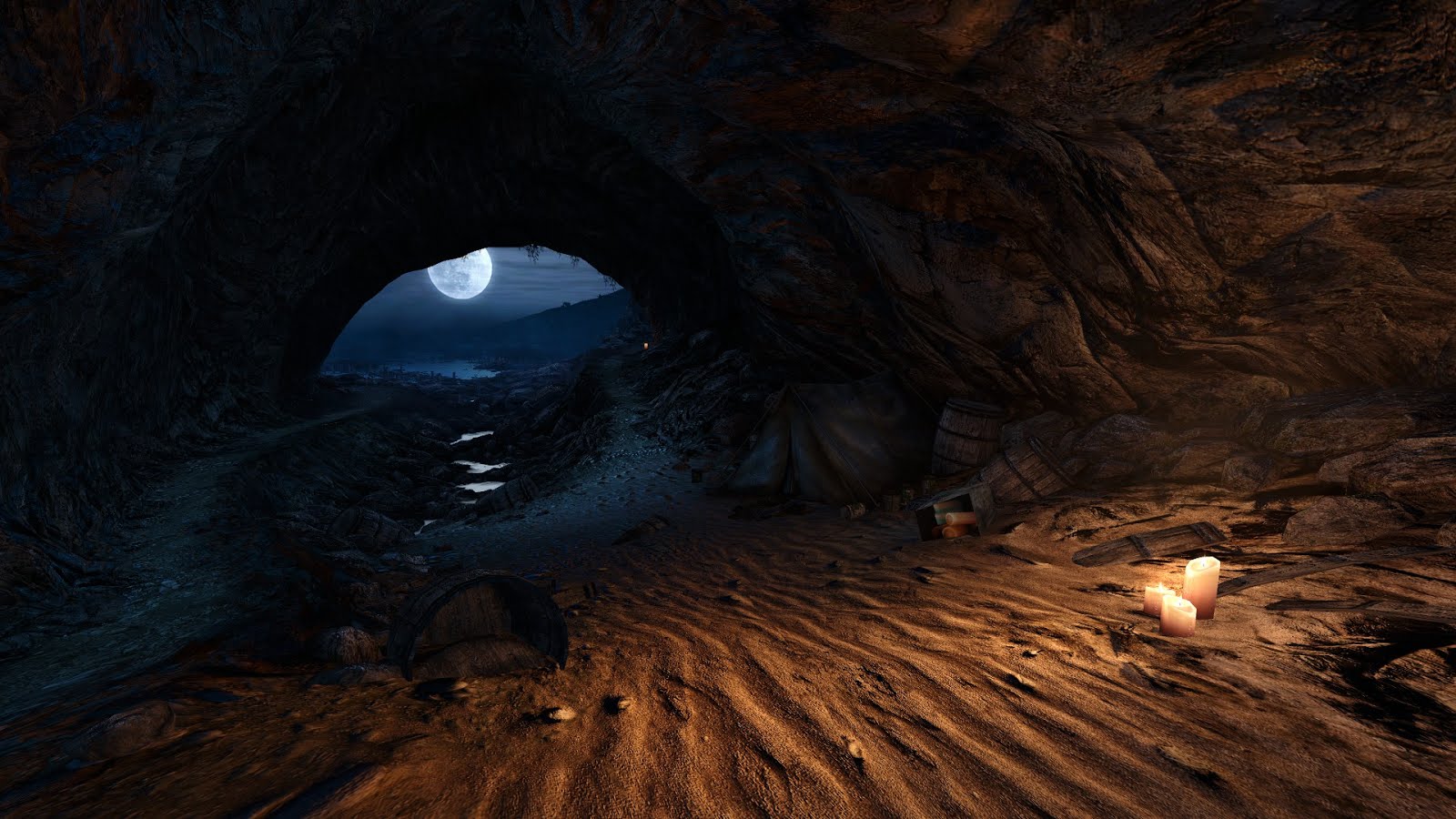
Dear EstherDear Esther tells its ambiguous story in a totally different way. You don’t click or interact with anything or anyone, you just observe as you move around the stunningly detailed landscape (or possibly mindscape) around you. The abandoned island you find yourself on, contains strange sights for you to see as you follow a long, winding way to a beacon blinking on the horizon. There are signs painted with luminous paint, lit candles in unlikely places and stranded boats of the wooden as well as the paper variety. A voice joins you now and then on your walk, dropping pieces of a sad and spooky story that must somehow be related to the island and its strangeness. The connection gets clearer as you go, but never completely solidifies. Apart from the voice, there are only ambient sounds and the occasional piece of piano, violin or choral music to break the silence. The sky is grey, overcast, with a ray of light in the distance. There’s a beautiful sadness to it all. The path you walk is very linear, the environment laid out in such a way that you can make a small extra detour, but never wander off in an unintended direction. There is no running, you move at a slow but steady pace. Those short on patience need not apply. Dear Esther only works if you give in to the mood of the piece: put on headphones, turn off the lights and preferably have a large, high-resolution monitor. Don’t expect action, more a meditation with hints of story. This meditation will take about 75 minutes to complete.

As you see: despite both being an experiment in storytelling, we have an apple and an orange here. I enjoyed Dear Esther more, because of the atmosphere. It’s funny that simply the act of moving yourself through the environment makes it a compelling experience, when the minor adjustment of watching the game as a movie would likely make you fall asleep by the midway point. Important note: the save system was messed up. If you don’t complete the story in its entirety at first, you may only be able to start at the beginning instead of at one of the other three chapters. Thankfully, there’s a work-around for this.

Anyway – I am off to be Batman again. As one does.

Saturday, January 12, 2013

Movie Review: Skyfall

Convoluted plots and unlikely action sequences have always been a staple of the James Bond franchise. (As well as hot women, exotic locations, gadgets and shaken-not-stirred martini’s, before sponsoring by Heineken perverted the latter.) But since Daniel Craig has taken on the Walter PPK of 007, the movies have tried to head into a grittier, relatively more believable direction. Skyfall, more than previous installments, puts the emphasis on characters and is unusually introspective. Respectful nods are made to Bond movies past and both Bond and his boss ‘M’ (Judi Dench) are reflecting on a career that is closer to the end than the beginning. As the story progresses, the scale of it seems to be shrinking and getting more personal, rather than growing bigger and being of import to the world at large. Unfortunately, as with The Dark Knight Rises, the realism makes the somewhat more ridiculous parts stand out in uncomfortable contrast.

For starters: what’s the deal with Evil Masterminds? Why do they feel the need to set up complicated webs of intrigue and precarious plans, full of unpredictable factors, when their end goal could obviously be reached in a much easier way? Because then there would be no movie, that’s why. Both MI6 and their adversary show some true foresight at points in the movie, while having strange blind spots at others. There were a few instances in which a car was at the ready to pick up someone at just the right place and time, despite these people just exiting a chaotic, unforeseen situation. And the way a mode of public transport is used effectively for a quick, spectacular escape at one point seems to give up completely on probability, sacrificing it on the altar of coolness (and, admittedly, it does look cool). There is an IT component to the plot and, as usually happens in movies, the sequences which attempt to make hacking look visually exciting seem to have no bearing on reality either. And dear screenwriters: our hero gets taken into an Evil lair, but no one thinks to give him a thorough body search? That signifies either sloppy henchmen or sloppy writing. (Who in their right mind would pass on a chance to give Daniel Craig a body search?)

While I do like Craig’s gritty Bond and the self-awareness about getting older and possibly having peaked already, I don’t like some of the characterization he’s been handed. Without getting too specific, there is more than one occasion in the film when Bond seems all set to act the hero, but only springs into action a moment or two after it’s too late. Maybe this was done to humanize him and make him feel more fallible, but it’s a jarring shift between this and his action hero mode. Also worrying, given the more realistic tone, is the disregard for collateral damage, be it of the material or innocent bystander variety. Must be a ‘greater good’ mentality.

The continuity between Bond movies remains somewhat baffling. It is understood that ‘M’ and ‘Q’ are codenames for a certain position within MI6 and that the title is passed on from one person to the next. Even Ms. Moneypenny could potentially be a code-name. But does the same count for the 007 moniker and the name James Bond? The numbers signify agents, but are we supposed to assume that the previous incarnations are all pushing up daisies? That doesn’t seem the case, as it’s made clear in Skyfall that James Bond is 007’s actual birth-name. (Weird that he would use his real name to introduce himself - “Bond. James Bond” – while on the job.) So then it seems that all James Bonds are indeed meant to be the same person, duplicating in slightly varying forms throughout the last 50 years, in what must be alternate realities. So there you go: it’s a scifi-franchise.

Is Skyfall the best Bond movie ever, as some people claim? No, I wouldn’t say so. But it is one of the most interesting ones, fleshing out the characters of Bond and M more than usual. It gives Judi Dench a lot of screen time, which is always a good thing. And it is notable for an unusual ending, that I unfortunately can’t get into without major spoilage. Despite a script containing plot holes that are hard to miss, as well as a generous helping of silliness, the movie is definitely worth seeing, for newbies and die-hards alike. The latter will likely get out of it the most out of it, though, being able to appreciate its cheeky winks to its heritage. I have it on good authority that James Bond will return.

Wednesday, January 2, 2013

Game Review: Spec Ops: The Line

I do not like military shooters and tend to avoid them like the plague. A lot of them are morally awkward, featuring mostly white Westerners shooting at whichever group of ‘others’ seemed the most threatening at the time the game went into production. Also, the online-multiplayer seems to be the main selling point for most of these games, and I don’t enjoy getting continuously ‘fragged’ or ‘pwned’ by foulmouthed teens who have spent all their time online practicing instead of developing social skills or getting laid. And finally: realistic shooters tend to bore me with their machismo and rabid patriotism. But then along came Spec Ops: The Line. It’s a military shooter, but it gathered so much buzz for its unconventional storyline that I decided to pick it up when I spotted it on sale.

You are Captain Martin Walker, a guy who at first seems like a cookie-cutter all-American hero. You lead a squad of three into Dubai, which has been hit catastrophically by sandstorms. Your job is to covertly find out what happened to a previous team – the 33rd battalion led by a certain John Konrad. It was sent to Dubai to evacuate the inhabitants that were left behind after the rich and powerful had fled the city. As you walk into an unclear situation with multiple factions fighting each other, mistakes are made which escalate the situation, including one as harrowing as I’ve ever witnessed in a video game. Walker’s mind and body take a severe beating and his team begins to doubt him. Depending on what you do during the final mission and the sequence that follows after the credits, it leads to one of four downbeat, existential endings. None of them include bunnies, rainbows or unicorns. Despite this, all of them are worth watching and profound in their own way.

Having been pre-warned by reviews that the parts where you shoot a literally unbelievable amount of opposing soldiers are fairly generic and turn into a slog near the end, I played through the game on ‘easy’. I can actually recommend doing that, if – like me – you just want to optimally experience the story (‘enjoy’ seems the wrong word). It improves the pacing as you won’t have to replay any of the lengthy and increasingly grim battles more than once. From a gameplay perspective, the actual shooting is indeed pretty standard apart from a mechanic where you can shoot glass that has sand on or behind it, to pour an avalanche over your enemies. Some people have complained about the fact that vaulting and melee combat were mapped to the same button, but I wasn’t hindered by this too much, engaging long-distance by preference. Dodging hand grenades is a pain, however, because sticking to cover, getting out of cover and running are all controlled by the same button. So if someone lobs a grenade at you, you have to carefully un-stick yourself and amble away from your cover far enough for you start running when you press that button again, instead of going right back into cover and getting blown up.

The game has been criticized for being hypocritical, discussing the horrors of war, while at the same time trying to entertain by way of gunfights. But the context of the shooting matters. Odd as it is, you feel somewhat guilty as you go through these sequences, but compelled to keep going because you want to see what happens next. And yes, there is heroic rock music playing on the background at points, which is obnoxious if taken at face value, but which contextually is clearly ironic, along the lines of that ‘America, f*ck yeah!’ song from the South Park guys. The gore may be entertaining to some people (and in some other games it is to me too), but here it mostly feels painful. The faces of the soldiers you kill are generally detailed enough that they become individuals when lying dead on the ground. At some point you hear a couple of guards having a very normal, humanizing conversation, right before you inevitably have to kill them. If you’re not engaging with the game intellectually, all you’ll see is a bland shooter. And you’d be missing the point entirely. In a strange way, it would be less fitting if the killing was very creative and a lot of ‘fun’. Admittedly, the fact that you can get ‘achievements’ for certain kinds of kills is a bit dubious, but to avoid a financial loss with expensive-to-make games like this, you have to please gamers of all kinds, not just the ones with a philosophical bent. So, yeah, the game does make a few concessions that slightly weaken its point.

Though some of the things you will see in Spec Ops: The Line are hard to watch, the graphics themselves are impressive and the sand swept environments are outright beautiful at times. For the atmosphere, the visuals and the story, I really recommend picking up the game if you catch it on sale. Run through it over the course of an afternoon on ‘easy’ to get the most out of it (and forget about the allegedly mediocre, tacked-on multiplayer component, which I ignored). Of course, alternatively you could just look up the cut scenes on YouTube. But when taken out of context and without the interactive element, I don’t think these scenes would have the same impact. To feel that, you have to identify with Walker, at least up to a point, and feel responsible for his actions. It’s not often that a war game lets itself get inspired by something as thoughtful as Joseph Conrad’s Heart of Darkness. (Note that the name of the ambiguous leader of the 33th battalion is Konrad.) If you’re a gamer on the look-out for something with substance, don’t miss out on this experience. Even – or maybe especially – if you normally hate military shooters.

Thursday, December 27, 2012

Metacriticism: Reviewing Reviewers

I am not sure how rare my condition is, but I am someone who loves reading/watching/hearing reviews. Even when they’re about something I have no actual interest in. For instance, I have spent more time reading about the Twilight phenomenon and watching the Honest Trailers, than I ever will spend watching the movies or reading the books. There is something appealing to me about analyzing culture (be it of the ‘pop’ or ‘high’ variety) and picking apart what makes something work or fail. It’s also what makes me write reviews myself. Though this may surprise and shock, I am not making any money on this blog, it’s mainly for sh*ts and giggles. And maybe worldwide fame.

But how much does someone else’s opinion matter, as there is no accounting for taste? Well, ultimately the only way to be certain if you would like something or not is to experience it yourself. The problem is that there is a LOT of entertainment out there and there is no way you can absorb all of it, past and present. To get the best out of your time investment, you’ll want to have the worst crap weeded out before you dive in. The distinction between good and great may generally be in the eye of the beholder, but the distinction between toxic waste and something worth your time is a fair bit more universal. And though there are rumored behind-the-scenes shenanigans going on at sites that group together reviews – sites like Metacritic, which covers tv, movies, video games and music – meaning you have to take the accumulated scores with a grain of salt, they do give you a good general idea about quality. And as you follow a certain reviewer you like, you will discover how his or her taste relates to yours and how you should interpret their opinion. The best reviewers realize that their reviews should be a form of entertainment. Here are a few I have been following and enjoying.

Roger Ebert - Though it’s fun to root for an underdog, sometimes there’s a reason someone is at the top of the heap. Though I don’t always agree with his ultimate judgement, he writes about movies thoughtfully and passionately and doesn’t forget to entertain. His reviews can be found online and collected in books, either by year or by rating. Though he refrains from cheap shots, occasionally he does rip a deserving movie apart and the collections of those kind of reviews will likely have you smiling the most.

Comedy Film Nerds - This is a podcast hosted by two stand-up comedians: Graham Elwood and Chris Mancini. They talk about upcoming movies and review new ones currently in the theater or premiering on BluRay or DVD. Generally there is a guest from either the movie industry or the comedy circuit. Breaks in the regular podcasting schedule are covered by less topical shows that discuss a movie genre or contain interviews with someone in showbiz. The banter is easy-going and funny, as you’d expect from two stand-ups, and it’s a great way for movie buffs to get informed while commuting, working out or otherwise multi-tasking.

Other good sources for movie reviews: The Internet Movie Database, Rotten Tomatoes, Rolling Stones’ Peter Travers, Catherine Reitman, MovieBob and DVD Verdict.

Zero Punctuation - It’s not often that a reviewer spawns imitators, but Yahtzee Croshaw (not actually his birth-name, as you may guess) has managed to do so. His reviews of video games are animated videos that run around the five minute mark. Against a bright yellow backdrop, simple black-and-white characters illustrate (or humorously add to) Yahtzee’s breathlessly read, sardonic opinions. These tend to be blunt and contain a creative collection of (sometimes self-made) swear words. Unlike in ‘normal’ reviews of games, there are no screenshots or videos of gameplay. A picture of the cover will pop up somewhere in the video and is likely to get savaged in one way or another. The reviews are impressionistic and more free-form than you’d get from a site like Gamespot or IGN. Assuming you’re on board with his brand of humor, you may find yourself binging on his videos at first and though the novelty wears off a bit, the charm remains. He posts a new review (almost) every week.

The Angry Joe Show - A clearly very enthusiastic gamer, Joe likes to get in-depth with his video reviews, which often run longer than twenty minutes. Standing in front of a related backdrop and aided by some nifty computer animations, he passionately describes his experiences. Unlike Yahtzee, he does show actual gameplay video, so you get a clear idea of the look of a game. There may also be dressing up and there may be little skits, which are sometimes funny and sometimes slightly off the mark. But as he is very articulate and engaging, the occasional joke falling flat isn’t a big deal.

Other good sources for video game reviews: GameRankings, WTF is..., Machinima, IGN, Gamespot, PocketGamer

The Dice Tower - Tom Vasel is a board game fanatic. His video reviews show the components of a game, give an overview of the rules and conclude with his opinion on what about the game in question works and what doesn’t. His videos are very family friendly. He apparently comes from a religious background and was even a pastor, which as a gay guy makes me slightly queasy about his non-board game related opinions. But I am just making assumptions as the reviews don’t stray at all from the topic at hand. The videos may occasionally co-star one of his six (I think) daughters. He’s a likeable guy and the leading reviewer in this field. There is also a podcast, though I haven’t listened to it.

Other good sources for board game reviews: BoardGameGeek, Board to Death TV

Comic Book Queers – This is a podcast on which a group of gay guys offer their (often conflicting) opinions on new comics and talk about current happenings in the comic book industry. As someone who used to be a big comic book fan, but now only occasionally picks up a graphic novel, it’s nice to hear what’s going on with all kinds of characters I used to read about. It’s telling that I enjoy listening to the podcast more than I enjoy reading comic books these days. (ps: there is also a – unrelated – Comic Book Bears podcast, but I haven’t checked it out yet)

Good source for book reviews: GoodReads

Mind you, the stuff I mention here is a fairly limited selection of what I have stumbled upon. I have skipped television and music entirely as I tend to through Metacritic to find reviews on these topics. I hope you will enjoy some of these reviewers – and hope you will still be reading my reviews as well, of course.

Please feed my ego by following this blog through Twitter, to get notified whenever I post a review here.

Tuesday, December 18, 2012

Movie Review: Looper

Looper is a futuristic action thriller that combines criminals, hover bikes, time travel and telekinesis to interesting effect. It starts both Joseph Gordon-Levitt and Bruce Willis as Joe, a ‘looper’. Loopers assassinate people that are sent back from the future by a criminal organization, for clean disposal. When they come to the end of their employ, the older version of them is also sent back in time in a process that is called ‘closing the loop’. They kill their older self, collect the gold that comes packaged with their matured version and enjoy an early retirement until such time that they get killed by their younger past self. See how this could get confusing? Well, things certainly do get complicated when older Joe (Willis) manages to escape and runs rampant in the past, trying to set things right for the future, requiring younger Joe (Gordon-Levitt) to go after him.

There’s a lot that works about this movie and there are only a few minor things that annoy. The telekinesis angle seems superfluous at first, but starts to make sense later on. The related special effect that’s used a few times to make a coin hover, looks glaringly fake however. Considering that it seems like such a simple and probably not too expensive special effect, that boggles the mind. But as nitpicks go, it’s a pretty small nit. A larger one is the make-up that was applied to Gordon-Levitt’s face to make it more believable that he would age into Willis. In a movie that requires us to buy into complicated time-travel scenarios and other flights of fancy, it seems odd to think that the audience needs face-altering make-up to go along with Joseph turning into Bruce. If anything, it’s distracting until you get past the “hey, that’s Gordon-Levitt, but he looks kinda weird” phase.

The acting is solid all the way round. You expect as much from the big names that come attached, but the show was stolen by the most ‘real’ and likeable precocious kid I’ve seen in a long time. He is completely believable, both when he’s being unnervingly mature and when he suddenly shows his actual young age and acts like a vulnerable kid.

Getting into the plot in detail… well, it’s hard to discuss it without avoiding spoilers. So instead, a note about time travel: there are only two approaches to this that avoid a paradox. The first one states that you can’t really change the past. If you go back in time to change things, it will turn out that you were in fact already a deciding factor in how things turned out initially. The second one states that you can change the past, but this will not affect your own past. Instead, it will create an alternate reality spinning off from the moment where you intervene (See: Star Trek). Any other form of temporal causality is likely to have you scratching your head. Changing your own past is bound to get fuzzy when it comes to logic. In Back to the Future, when time-travelling Marty McFly messes up how his parents initially meet, he should have disappeared. (I’d say instantly, the movie says gradually.) But then, if he never existed, he never would have derailed their meeting, so he would have existed as before and messed up their meeting again. (Sidebar: scifi comedy series Red Dwarf cheerfully thumbs its nose at this kind of temporal logic by having Lister be his own dad.) I could go on about time travel a lot longer, but just read my reviews of Doctor Who and Terminator: The Sarah Connor Chronicles for more ranting on the topic.

Looper doesn’t avoid paradoxes in the end, though things seems neatly wrapped up at first glance. The narrative falls apart when you start to think things through, in ways I can’t explain without spoiling the ending. But the movie is undeniably entertaining, so it’s probably best if you don’t give it a second thought and just enjoy the ride.