![]() |
| Tomb, sweet tomb. |
![]() |
| Old statues. They tend to harbor secrets. And look really angry. |
![]() |
| The longest train in human history. |
![]() |
| Tomb, sweet tomb. |
![]() |
| Old statues. They tend to harbor secrets. And look really angry. |
![]() |
| The longest train in human history. |
Lara Croft is an ambivalent creation, like most female characters in video games. She is empowered and doesn't need a man to come to her rescue, but she has also been designed to please hormonally bothered teenage boys. Traditionally, she had a tiny waist and sported considerable cleavage. And though she went about kicking ass, there were flashes of what seemed to be misogyny in the elaborate death scenes that would occur when a button prompt was missed or a jump went wrong. There are even gleeful collections of Lara's death scenes on YouTube.![]() |
| I'm not saying that I'd like to build a summer home here, but the trees are actually quite lovely. |
![]() |
| She's going deeper underground. |
![]() |
| Nothing's gonna stop her now. |
![]() |
| Ancient civilizations. And a hot babe. |
Thirty Flights of Loving – In this highly stylized short story that takes about fifteen minutes to ‘play’ from beginning to end, you’re part of a trio executing a heist. There is no dialogue, barely any text and you see everything from a first person perspective. Most interesting about this flight of fancy is the use of jump cuts. You may find yourself running down a hallway only to suddenly be in a different scene, be it one taking place earlier or later. Apart from moving around and being able to click on things to move the plot forward, you have no influence on the course of events. Thirty Flights is the sequel to the equally experimental Gravity Bone, which shares its colorful, primitive graphics but has a few more traditional gameplay elements and a great, cinematic final scene. In this earlier game, you play the part of a contract killer, but things get silly; at some point you have to take photographs of birds which afterwards explode for some unknown reason. On Steam, Gravity Bone comes packaged with Thirty Flights and there’s a text commentary option for the latter that gives insight into the making of it but does not clarify the story. ‘Playing’ both stories and reading the commentary will not take more than an hour in total and it’s certainly worth picking up for the curiosity value, assuming you find it on sale. I don’t quite get why the reviews have been so massively positive though. Granted, it’s novel to apply artsy cinematic ideas to a slightly interactive animated short story, but the end product doesn’t seem all that substantial from a story perspective. To me the ‘games’ seem to be stuck in a weird and slightly uncomfortable Limbo between a game and a short film.
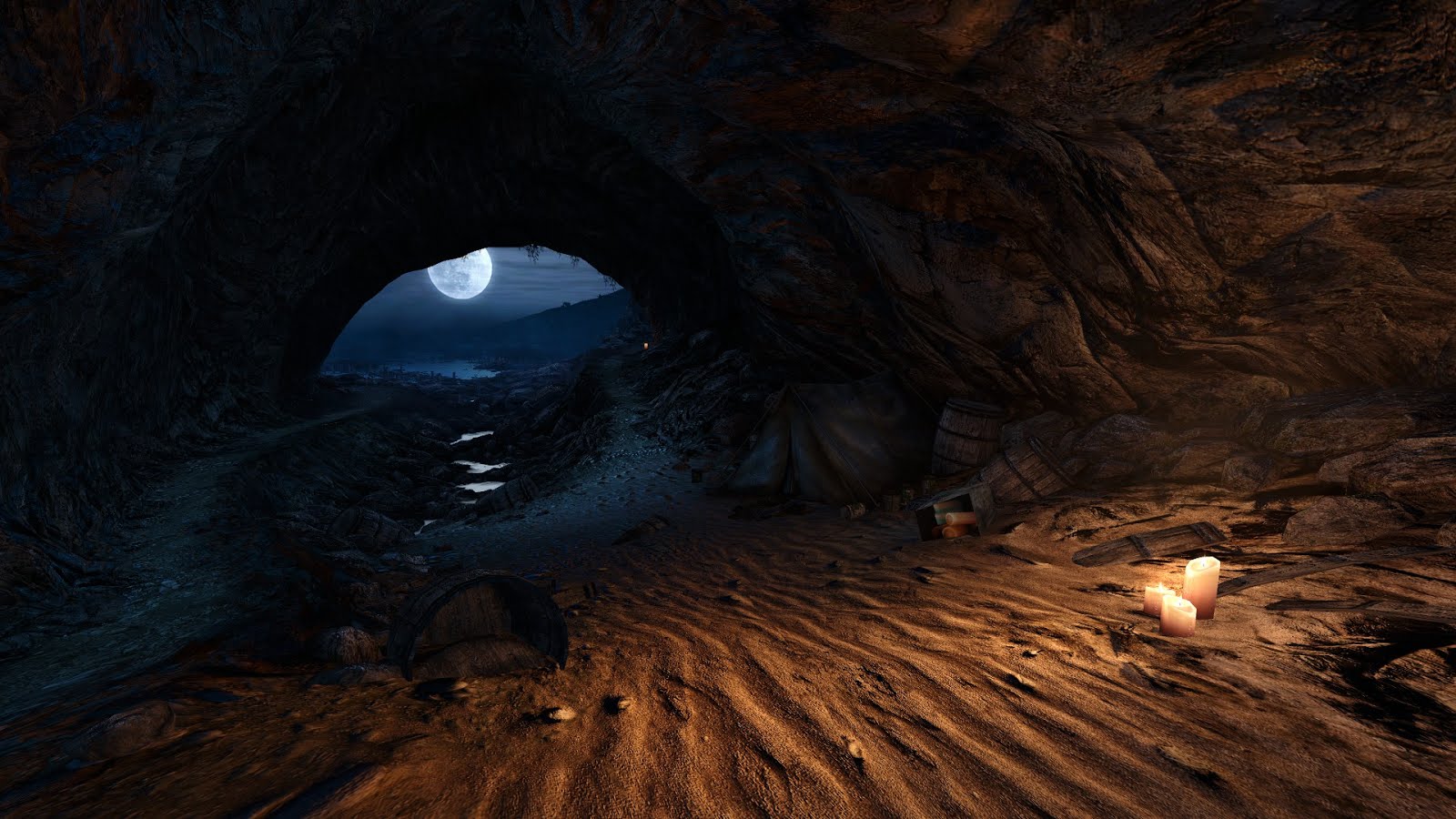
Dear Esther – Dear Esther tells its ambiguous story in a totally different way. You don’t click or interact with anything or anyone, you just observe as you move around the stunningly detailed landscape (or possibly mindscape) around you. The abandoned island you find yourself on, contains strange sights for you to see as you follow a long, winding way to a beacon blinking on the horizon. There are signs painted with luminous paint, lit candles in unlikely places and stranded boats of the wooden as well as the paper variety. A voice joins you now and then on your walk, dropping pieces of a sad and spooky story that must somehow be related to the island and its strangeness. The connection gets clearer as you go, but never completely solidifies. Apart from the voice, there are only ambient sounds and the occasional piece of piano, violin or choral music to break the silence. The sky is grey, overcast, with a ray of light in the distance. There’s a beautiful sadness to it all. The path you walk is very linear, the environment laid out in such a way that you can make a small extra detour, but never wander off in an unintended direction. There is no running, you move at a slow but steady pace. Those short on patience need not apply. Dear Esther only works if you give in to the mood of the piece: put on headphones, turn off the lights and preferably have a large, high-resolution monitor. Don’t expect action, more a meditation with hints of story. This meditation will take about 75 minutes to complete.
As you see: despite both being an experiment in storytelling, we have an apple and an orange here. I enjoyed Dear Esther more, because of the atmosphere. It’s funny that simply the act of moving yourself through the environment makes it a compelling experience, when the minor adjustment of watching the game as a movie would likely make you fall asleep by the midway point. Important note: the save system was messed up. If you don’t complete the story in its entirety at first, you may only be able to start at the beginning instead of at one of the other three chapters. Thankfully, there’s a work-around for this.
Anyway – I am off to be Batman again. As one does.
You are Captain Martin Walker, a guy who at first seems like a cookie-cutter all-American hero. You lead a squad of three into Dubai, which has been hit catastrophically by sandstorms. Your job is to covertly find out what happened to a previous team – the 33rd battalion led by a certain John Konrad. It was sent to Dubai to evacuate the inhabitants that were left behind after the rich and powerful had fled the city. As you walk into an unclear situation with multiple factions fighting each other, mistakes are made which escalate the situation, including one as harrowing as I’ve ever witnessed in a video game. Walker’s mind and body take a severe beating and his team begins to doubt him. Depending on what you do during the final mission and the sequence that follows after the credits, it leads to one of four downbeat, existential endings. None of them include bunnies, rainbows or unicorns. Despite this, all of them are worth watching and profound in their own way.
Having been pre-warned by reviews that the parts where you shoot a literally unbelievable amount of opposing soldiers are fairly generic and turn into a slog near the end, I played through the game on ‘easy’. I can actually recommend doing that, if – like me – you just want to optimally experience the story (‘enjoy’ seems the wrong word). It improves the pacing as you won’t have to replay any of the lengthy and increasingly grim battles more than once. From a gameplay perspective, the actual shooting is indeed pretty standard apart from a mechanic where you can shoot glass that has sand on or behind it, to pour an avalanche over your enemies. Some people have complained about the fact that vaulting and melee combat were mapped to the same button, but I wasn’t hindered by this too much, engaging long-distance by preference. Dodging hand grenades is a pain, however, because sticking to cover, getting out of cover and running are all controlled by the same button. So if someone lobs a grenade at you, you have to carefully un-stick yourself and amble away from your cover far enough for you start running when you press that button again, instead of going right back into cover and getting blown up.
The game has been criticized for being hypocritical, discussing the horrors of war, while at the same time trying to entertain by way of gunfights. But the context of the shooting matters. Odd as it is, you feel somewhat guilty as you go through these sequences, but compelled to keep going because you want to see what happens next. And yes, there is heroic rock music playing on the background at points, which is obnoxious if taken at face value, but which contextually is clearly ironic, along the lines of that ‘America, f*ck yeah!’ song from the South Park guys. The gore may be entertaining to some people (and in some other games it is to me too), but here it mostly feels painful. The faces of the soldiers you kill are generally detailed enough that they become individuals when lying dead on the ground. At some point you hear a couple of guards having a very normal, humanizing conversation, right before you inevitably have to kill them. If you’re not engaging with the game intellectually, all you’ll see is a bland shooter. And you’d be missing the point entirely. In a strange way, it would be less fitting if the killing was very creative and a lot of ‘fun’. Admittedly, the fact that you can get ‘achievements’ for certain kinds of kills is a bit dubious, but to avoid a financial loss with expensive-to-make games like this, you have to please gamers of all kinds, not just the ones with a philosophical bent. So, yeah, the game does make a few concessions that slightly weaken its point.
Though some of the things you will see in Spec Ops: The Line are hard to watch, the graphics themselves are impressive and the sand swept environments are outright beautiful at times. For the atmosphere, the visuals and the story, I really recommend picking up the game if you catch it on sale. Run through it over the course of an afternoon on ‘easy’ to get the most out of it (and forget about the allegedly mediocre, tacked-on multiplayer component, which I ignored). Of course, alternatively you could just look up the cut scenes on YouTube. But when taken out of context and without the interactive element, I don’t think these scenes would have the same impact. To feel that, you have to identify with Walker, at least up to a point, and feel responsible for his actions. It’s not often that a war game lets itself get inspired by something as thoughtful as Joseph Conrad’s Heart of Darkness. (Note that the name of the ambiguous leader of the 33th battalion is Konrad.) If you’re a gamer on the look-out for something with substance, don’t miss out on this experience. Even – or maybe especially – if you normally hate military shooters.
Despite being a grade A boozehound, as well as addicted to painkillers which magically heal bullet wounds, Max’s reflexes are apparently still superhuman. As before, his speed and marksmanship are portrayed in the form of Bullet Time. This gameplay conceit was made popular by the first Max Payne game and has been incorporated in so many games since, that it has almost become cliché. It means that you have the ability to see things happen in slow-motion while you can aim and shoot in real-time. So you can take a leap sideways or forwards, sailing majestically through the air, while strategically pumping bullets into various parts of your enemies as their bullets whiz past you slow enough to see them travel. You will need to make use of this tactic a lot. A mechanic that allows you to take cover has been added this time around, giving you a few more strategic options, but because your foes tend to come running at you and silencers aren’t effective, stealth is short-lived and things tend to get hectic. Thankfully, you also have the option to blow up cars, gas tanks (and so on) near your enemies by shooting them, meaning you can cut down enemy numbers at a good pace.
Max has a low tolerance for bullets, by game standards (though he is still a fair bit more resistant than people are in real life), meaning you don’t last long at the normal firing rate. So you will find yourself suspended in midair quite a bit, possibly ending your journey sooner than planned by embarrassingly crashing into a wall or some other obstacle that you didn’t notice before taking flight. Though it looks silly, it does give the action movie acrobatics a charmingly realistic counterpoint.
Seeing how your survival often depends on taking out multiple targets on the go, before time resumes its normal speed, it’s annoying that the game doesn’t make it clear when an enemy is down for the count. When you hit someone, they will drop to the ground, but the amount of bullets it takes to keep them there is unpredictable. You are likely to find yourself getting shot in the back now and then, because one of the guys you thought was dead – a reasonable assumption after emptying a clip on him – was actually just mildly inconvenienced.
Max Payne 3 looks great. The beautifully detailed surroundings invite you to look around and there are rewards when you do so in the shape of ‘clues’ to be found and parts of guns that – if you collect them all – give a bonus on damage and ammo capacity. But the game is schizophrenic when it comes to pacing; often, if you take a moment to wander off the beaten path to find these goodies, either Max’s voice-over or a character you have with you, will remind you that time is of the essence and that you really should be hauling ass.
Unfortunately the game is not without bugs and glitches. Some are hilarious one-offs, such as the time when Max, after landing on the floor on his back, started spinning around like a break-dancer on speed. (Other players have encountered the same glitch in different spots.) I also had a moment when, right after coming back to life, I was glitched to the wrong side of a wall and found myself at the end of a level, not able to proceed. There are a few recurring problems that are more annoying though. There is a targeting aid, that on the normal setting provides just about the right amount of guidance given the fast-paced shooting. But it did on occasion lock on an enemy that was out of range while there were other, more viable targets right in front of me. And most critical is a bug that started occurring in the last couple of chapters and raised the difficulty level from challenging to frustrating. Apparently at random, Max would seize up while in cover, able to reload his gun but unable to otherwise move, aim or shoot until someone came along to put a few bullets in him and trigger a ‘last man standing’ slow-motion shoot-out. (This mode itself also has a recurring bug: you sometimes will be looking at your assailant while your gun appears to be stuck in a different direction.) These bugs don’t spoil the experience ultimately, but they are surprising given how polished the game looks and sounds otherwise.
Essentially, Max Payne 3 is a very well-presented and very linear procession of shooting galleries that tells a convoluted and somewhat hard to follow story. Max is a well-drawn character in both meanings of the phrase and his gloomy attitude makes sense considering his history. Most chapters of the story see him failing at his main objective, only adding to his troubles. But listening to narration by someone whose demeanor is basically ‘Eeyore with a gun’ for an entire game, does start to grate a little. The combination of Bullet Time and cover-based shooting is fun but does get repetitive, despite a large arsenal and despite special sections that shake up the formula. On normal difficulty it’s pretty challenging to someone like me who sucks at shooters, but if you have to replay a certain part often, the game self-adjusts the difficulty level momentarily by throwing you some extra health. Because of this and because your enemies always start out at the same position, you’re unlikely to get stuck for long (well, maybe literally; if that bug acts up).
At one point, Max says: “Sometimes a complicated problem is best tackled with a simple solution.” His solution is always the same: shoot a whole bunch of bad guys. That is great fun for a while, but by the end of it, you’ll likely be craving something less restrictive and linear.
While the comic and the television series focus on the story of former policeman Rick Grimes, his young son and the people he encounters, the game serves as a spin-off prequel to both. One of the characters that will go on to appear in both the comic and television series pops up before heading off to his twofold fates, but the lead is new: Lee Everett. He was on his way to prison when the world went mad, gets liberated because of it and soon stumbles onto an abandoned little girl (Clementine) he feels compelled to protect. Like Rick Grimes, he becomes part of a group with more than its share of power struggles and infighting, while taking care of a kid. He finds himself continuously having to take sides and make life-or-death decisions. Who does he pick when he can only recue one out of two people? When he spots a woman too far off to save, being attacked by zombies, does he let her die screaming to keep drawing attention to herself and away from him as he gathers vital supplies for his group? Or does he mercifully shoot her, which would draw the zombie-mob his way?
More than anything, The Walking Dead in its game incarnation is about interactive storytelling. There generally isn’t an obviously right or wrong solution to the morally muddy questions it asks and no matter what option you go for, you’re likely to piss off someone in your group. This isn’t necessarily something new and has been seen in games like the Mass Effect and Dragon Age series. But unlike in those games, where the dialogue and interaction between characters serves as an enticing backdrop to the action-packed meat of the experience, here the story is the main course. Sure, there are some bursts of action to keep you on your toes and there is the occasional traditional point-and-click problem-solving along the lines of ‘find this item and then use it on this person or thing to move the plot along’. But it’s all in service of the tale being skillfully told: it looks like a well-drawn, gritty graphic novel, the people Lee encounters are interesting and are always a bit more complex than they seem at first glance and the voice-acting is great. The combined effect is that you feel involved as you make your choices and see the sometimes unpredictable consequences. You care about the members of your little group. While kids can easily grate if written wrong, Clementine does make you want to keep her alive at all costs. And when the game makes you pick between two likeable people, knowing the other person will die, it hurts.
A very effective gameplay mechanic, which is a new one as far as I know, is that you only have a limited time to pick a reaction/response from the up to four options you get when having to make a decision. How much time you are given exactly, is contextual. If you are asked for your opinion in the middle of a discussion, you don’t have forever, but longer than when you have to convince someone to jump off a bridge onto a fast-moving vehicle. This forces you to be fairly spontaneous and in-the-moment, making your responses more honest: you tend to go with how you think you would really react under the given circumstances. This way, I discovered I would likely be very diplomatic, protective, suspicious and mostly very moral, though occasionally giving priority to pragmatism. And I did kill someone I didn’t technically need to. But he was a very, very bad man. The speed at which you have to read and respond make this game unsuitable for people with dyslexia and you are likely to accidentally select an unintended response once or twice. If you feel really annoyed about that, thankfully you can ‘rewind’ to the beginning of the chapter you messed up and set things right. Or as right as they get in the The Walking Dead universe, which is fuelled by hope, but dotted with the violent deaths of people who don’t deserve such a fate.
Speaking of gameplay issues: I have heard grumblings about them and the technical performance on various platforms, the iPad version being especially choppy, but my PC version was mostly fine apart from one memorable occasion on which I got eviscerated by a zombie for about ten times in a row because it was unclear which contextual button I was supposed to press in the second or two allotted to me. It ultimately is just a minor annoyance though and it won’t ruin the game for you.
The makers of the game claim that by the end of the five-part ‘season’ players will have much- different sets of survivors and allegiances. Much as I am enjoying the game, I unfortunately have to call shenanigans on this. Playing is engrossing and as addictive as reading a great book, making it hard to stop because you want to know what happens next. But the further you get into the story, the clearer it becomes that a lot of your choices don’t really matter in the long run. Circumstances beyond your control wipe the slate clean partly and invalidate a lot of your earlier hand-wringing. It makes perfect sense that the writers can’t let the plot get away from them and evolve into entirely separate stories, so like in Mass Effect they find ways to lead the various narrative paths back to the same seemingly fated main events. Different characters may fulfill the same roles and scenes may play out differently but have the same outcome. The flavoring is different, but it’s mostly the same dish. One day, someone will hopefully succeed in the nigh-impossible task of combining very tight storytelling with giving the player a lot of freedom, but The Walking Dead doesn’t quite crack that nut.
Due to the big success of the game version of The Walking Dead, a second ‘season’ has already been announced and I have mixed feelings about this. Though the franchise was always conceived as a zombie movie that doesn’t end, this makes it seems likely they will kill off all but one or two of the current cast in the end to have players start in the exact same place in season two, all previous decisions null-and-void. Then again, they may have an open ending, leave this group to their unknown destiny and jump to a fresh set of characters. Either way, despite not quite making good on the promise of wildly diverging paths, I am hooked and will be there to see where it all leads.
Saint’s Row: The Third is not surprisingly the third installment of a franchise, one which ran parallel to GTA for a while: in both series you play a gangster in a big, sprawling city that is your playground and you can engage in various criminal activities all over the place to your heart’s content. There is a storyline running through the main missions and there are optional activities that can also be played separately from the story as mini-challenges trying to beat your own initial score and to evolve your character while gaining assets. Most GTA games were somewhat serious even if they cracked more of a smile during the San Andreas and The Ballad of Gay Tony incarnations. Saint’s Row started out serious, got goofy in the second installment and in its third outing has cut ties with reality completely and exploded into an orgasmic celebration of absurdity. The game is crass, juvenile and a whole lot of fleeting fun.
It starts at full speed with a spectacular bank heist gone wrong, then sees you skydiving through the length of a plummeting plane and have a gunfight in midair while holding a teammate who is cussing you out for being an inconsiderate asshole. It plays like a parody on action movies. The story boiled down: you want to take over the city of Steelport with your gang and are eliminating competition while fighting the authorities who are trying to take you down. Absolutely no one cares about collateral damage, be it to property or civilians. To call the main concept a story - with a proper beginning, middle and end - is actually giving it too much credit; it’s more like a series of ludicrous vignettes strung together tenuously. Consequences of plot don’t impact your free-reign activities all that much. Early on you get a penthouse for you and your homies, which is later besieged and blown up. However, it is magically restored once the mission in question ends and you can still go out on the town without getting instantly apprehended.
As if the situations you end up in aren’t silly enough as-is, the game encourages you to keep pimping your character to look as odd as possible, making the cutscenes he is placed in look even more crazy. For most of the game, my counterpart was a shirtless, black muscleman with a big dragon tattoo on his chest, runny mascara under his eyes and an odd hat. He proved he could maintain a good sprint while in high heels and carrying a rocket launcher. You can also decide on the look of your gang, making them as outlandish as you feel like. However, the design of your main sidekicks, who follow you on the story missions and feature in the cutscenes, is non-negotiable and interestingly, the game does manage to make you care about them a little bit at least among the vague suggestions of a plot. This is because the voice-acting is decent and though some of the jokes fall flat, a lot of the dialogue is at least smile-worthy. I didn’t use the ‘default’ voice offered for my alter-ego, but selected one (‘Male Voice 2’) that seemed to fit better with my look as described, so I can’t judge on the quality of the other leads. The game offers three male options, three female ones and there is even a ‘zombie’ voice option, making you simply groan unintelligibly whenever you would normally speak. Have I mentioned yet that the game doesn’t take itself seriously? Special voice acting mention goes out to the woman playing the nasally radio newscaster who always reads out a drily comical synopsis of whatever crazy event just happened.
Identification with your alter-ego gets a bit complicated as he comes with a spinning moral compass. On the surface, he seems a charismatic and friendly guy who cares about and is loyal to his sidekicks. Undeniably, however, he is a drugs and arms dealing pimp and a gang leader who slaughters untold numbers of innocents in pursuit of his self-interest, without a second thought. Mass murdering psychopath just about covers it. The general populace in Steelport seems to have extremely mixed and fluid feelings about him and his gang The Saints: one moment he is a hero, the next a menace and back again. There are stores selling Saints merchandise in the game, which is likely supposed to be a cynical comment on fame.
Given the overall tone and the fact that you are being handed toys to cause mayhem on a grand scale at every turn, it is nearly impossible to resist the cathartic urge to cut loose and act like a supervillain. I bought the game during a Steam sale, bundled with some extra DLC. Among other things, I was handed a bonus car that sucks up people when you bump into them and then allows you to shoot them out from a cannon mounted to the top and a gun that shoots chum, causing a shark to burst out from the ground underneath, dragging whatever victim I was aiming at down implausibly. The game is good at delivering these short-lived visceral thrills, throwing as many of them at you as it can come up with, terrified that you will get bored. And indeed, you are always veering between excitement and boredom because a lot of it seems a bit pointless. The main missions keep throwing stuff at you as a reward, adding cars, planes, weapons, outfits, allies and strongholds to your inventory and some of these can be upgraded to be even more cool, but it starts to feel like overkill. There is much more stuff than there is use for. And the mini-challenges that are left for you to take part in all across the city once the main story runs out, lack a purpose. You’ll level up your character, take over more of the city and get even more money to buy even more stuff, but for what? The pacing seems off, the game giving you a bit too much, too soon. On the other hand, if you enjoy the game as just a violent, crazy sandbox with plenty of options to act out in, without any real context, that is what the game provides pretty much from the beginning.
Though this caricature world of bimbo’s and himbo’s is ultimately somewhat insubstantial, I did have a great time playing around in it. The fact that I finished the main missions, unlike during my GTA experiences, is an indication of that. I kept being curious about what weird stuff they would come up with next. Because it doesn’t take itself the least bit serious, I could feel guilt-free about giving in to my more Evil and destructive side. Fans of lamely funny, politically incorrect humor, bizarre flights of fancy and incoherent action will definitely get their money’s worth. It’s a shame that the narrative – such as it is – hits a brick wall ultimately: it ends with little advance warning and plenty of dangling plot threads. Probably the intent is to wrap it up in a sequel or with DLC. (EDIT: Actually, I just realized that there is an alternate ending (SPOILERS) that does provide more closure, but requires you to make a painful sacrifice.) As for how long you’ll stick around once you’ve finished the main campaign and tried all the different types of activities once or twice – probably not that long. But Saint’s Row: The Third makes for a fun and imaginative walk on the wild side while it lasts.
Developer BioWare did a great job of telling an epic scifi tale, spanning three games, that could be shaped by the player, even if all the tales moved through a lot of the same events and ultimately ended up in the same place. A giant roster of interesting and mostly likeable characters followed you along, their number growing as you progressed, some of them falling by the wayside as a result of decisions you made. Sometimes these decisions were made in an earlier game, meaning a serious investment of time if you’d want to go back and correct them. I was lucky in that the only comrades I lost all went by way of noble sacrifice rather than anything simply tragic. (For which there is ample opportunity, which I only realized after watching different possible outcomes of events on YouTube.) To be fair, the third game doesn’t add a lot of new characters, mostly reintroducing the survivors from the first game as playable ones and giving all – yes, ALL – of your surviving former squad mates from the second game a cameo and providing satisfying closure to their stories in one way or another. As I didn’t lose anyone from that second game, it turned into quite the reunion in my version of the story, familiar faces popping up at every turn.
The few new characters Mass Effect 3 adds are mostly a bit ‘meh’. There’s a gung-ho, boring muscleman, there’s a somewhat arrogant and obnoxious alien you can only acquire by buying separately as downloadable content and there’s an AI (artificial intellicence) who is the most interesting and funny (semi-)new addition. There are also new people on board of your trusty spaceship The Normandy whom you don’t control as part of your squad who but who you interact with and potentially romance through conversation. Among these is a first for the series: a gay male love interest. Your shuttle-pilot Steve Cortez lost a husband tragically and is yours to emotionally support and then to roll around with if you feel like it. Though you could romance a woman as a female Shepard (FemShep in fan-slang) in part 2, supposedly a gay male romance option couldn’t be worked in due to logistical and time-constraints according to BioWare. But giving in to the criticism that it can’t be that much work to switch around some pronouns in a cut-scene that for the rest just switches out participants, they have now remedied the situation. There is a second and more interesting gay male romance option as well: if Kaiden Alenko survived your version of Mass Effect 1, you can move on from comrade-in-arms bromance to full-on romance, despite him not showing any interest of the kind back then. Unlike Cortez he is not gay-all-the-way however and can also be romanced if playing as FemShep. There was a predictable outcry from sexually insecure gamers and right-wing, nutbag ‘family groups’ who felt violated somehow that a character would matter-of-factly state same-sex interest and when shown enough friendliness even make a polite pass at the player. Thankfully, there was an equally strong backlash telling these people to shut the fuck up and just not go down that completely optional path. Which actually rings true for real-life as well.
Though Mass Effect 3 is mostly the pay-off to part 2’s set-up and these two very similar parts are stronger when seen as a whole, there are some minor changes to the gameplay. There is no more boring scanning of planets, looking for rocks and minerals to upgrade your equipment, though the same galaxy map is now used to make you scan for War Assets, needed to increase your forces against the coming Reaper invasion. While somewhat amusing for a minute or two, it feels like padding and a waste of time. Further streamlining to just the best bits would have been welcome. The hacking mini-game was thankfully ditched and there are more options to upgrade weapons this go-around, bringing back elements from the more fiddly and RPG-oriented Mass Effect 1. There were also a few more minor recurring bugs to contend with: Shepard would occasionally ignore one of my commands and had a tendency to stick to cover unintentionally when moving around the battlefield.
A new multiplayer mode lets you fight with friends against hordes of enemies from the Mass Effect universe. As I tend to have zero interest in multiplayer unless it’s local split-screen, it was annoying that BioWare linked these modes to the single-player campaign. To get the highest score and therefore the ‘best’ ending to your tale, it helped to either play the multiplayer or to play one or two not-all-that-great side games available on the iOs operating system. Doing this gave you a score-multiplier in your single-player game. I can see how a developer would want to give players a gentle nudge to try out all aspects of their franchise and acquire add-ons, but it seems very wrong to practically force players into a multi-platform experience and to fuse a multiplayer element into their singleplayer game. I do hope that this mixing won’t become a trend: I mostly like my games to be a solo experience and presented as a complete, self-contained package.
Publisher Electronic Arts (EA) and BioWare got flack for the above but also for some other dubious practices: Mass Effect 3 has an ’extra’ available character for your squad with associated missions, who could be bought as downloadable content the day the game was released. The base code for this content was already present in the released game. Admittedly, there is time between the development wrapping up and the distribution of a game and BioWare’s/EA’s defence has been that the time was needed to complete the programming on it. But if the content is integral (if not crucial) to the main game, it is not surprising that you alienate fans who bought the game full-price as soon as it was released and now have to shell out even more for the ‘complete’ experience straight away.
With Mass Effect 3, as with most other games these days, it seems that most loyal, eager fans actually got the worst deal. It’s common for gaming companies to reward early buyers, to make sure they buy the game full-price, rather than wait a few months to get it massively priced down (as generally happens with games). But it’s becoming pretty much standard practice that releases are rushed out the door while still containing a fair amount of bugs, which may do things like corrupt your game-saves or crash your game, requiring downloadable patches to be installed to fix them. In the case of Mass Effect 3 there was a bug that caused people who created their own look for the lead character in Mass Effect 1 and then carried it over to the other games, being unable to import ‘their’ face. (An odd oversight, considering that bringing along ‘your’ character through the entire trilogy was a big selling point.) I also ran into this problem and though it possibly shows how much of a nerd I am, I put off playing the game until the issue was (mostly) fixed, not willing to play on with a character who didn’t look like ‘my’ Shepard. By the time BioWare corrected the error, I could have bought the game a lot cheaper. The most logical thing gamers can do to not support this pay-the-most-get-the-worst system, is to wait out the inevitable bug fixes and then buy the game for less. However, as hype tends to rule and people are impatient, I don’t expect the system to change.
Business gripes aside, I love the mostly serious, sometimes silly and generally cheesy Mass Effect universe. There is a lot of attention to storytelling detail and effort made to build something that feels alive even outside of your own story. For example: as you walk around the space station called The Citadel, you will hear snippets of random conversations a you pass chatting couples. Each time you pass a particular set (who will remain lingering in the same place bizarrely even when you leave for a long period of time), the conversation will advance a little, until you’ve heard their whole story which possibly includes a surprise or twist. (After which, again somewhat bizarrely, the conversation loops back to the beginning.) You do have to be on your guard and take every chance you get to start up a conversation, be it with strangers or your crew. I accidentally dropped out of my by then ‘long-term relationship’ with the blue-skinned Liara, dating back to Mass Effect 1 (literally), because I missed a meeting in which I was supposed to reaffirm it and I was mightily confused when she started acting distant. I could only fix it by going back and replaying a few missons.
There has been backlash about the ending(s) to the main plot, which is being remedied by BioWare releasing free downloadable content to expand on it, explaining things a bit more. I am curious to see what they’ll do and have to agree that the entire climax narratively disintegrates when exposed to logic, but ‘my’ ending contained a visual so massively, lovingly cheesy in a sci-fi-from-the-50’s kind of way, that I was able to forgive the shortcomings. I am tempted to replay the games as a renegade kick-ass FemShep, instead of my paragon, noble male Shepard, making different decisions, but as I pretty much got the best result the first time around and it would be a massive time investment, I doubt I’ll get around to it. When it comes to exploring alternate outcomes in alternate realities, thankfully there are rabid fans who have put it all on YouTube. Farewell Shepard, it was great being you.
Deus Ex: Human Revolution takes place in a moody tech-noir near-future in which nearly everyone seems to have settled on a yellowish color scheme. And more importantly: people are getting ‘augments’, technical enhancements grafted onto or into their body, which give them special abilities. This is the big moral issue of the era: should people be getting such augments or does it make them less than human somehow? To what degree should it be allowed and regulated? Will it create a new class of humans, leaving the regular folk behind? And as people who have been augmented need to keep taking expensive medication to keep functioning, does this put them at the mercy of big corporations, who could ultimately use them to do their evil bidding? People ponder these ethical questions and – it seems – little else. Overheard conversations, newscasts, strewn about newspapers and e-books almost completely focus on the same topic, which does give it some weight but also makes the game world seem small somehow.
My personal approach: I always started with stealth, knocking out as many guards as possible for the experience points. If I got caught and/or bored I would clear an area with my non-lethal tranquilizer dart gun (looking back, I’d advise the stun gun instead) or the more lethal 10mm, shotgun or revolver. Due to your limited inventory, the game constantly has you weighing exciting new weapons against sticking with the ones you have lovingly upgraded. I stuck to my guns, so to speak. I hacked any computer I could find even if I had a password at the ready, also for the experience points. Then I went looking around the areas I’d cleared for hidden paths. Regularly when I thought I was going somewhere new, I found out I had actually discovered an alternate route into the place I just left. Though you do have to upgrade some of the hacking and stealth skills a little, on the whole it’s best to focus on those that allow you to find these routes, by lifting the heavy objects blocking them, busting through walls, jumping higher or falling down from a height without killing yourself. Also an augment to put on your shopping list early-on is the ‘social enhancer’ which allows you to manipulate people in conversation into doing what you want, which really helps along the main story. Beware: some of the available augments are actually completely useless, so think about the practicality of them before potentially wasting a Praxis.
Deus Ex: Human Revolution is a prequel to Deus Ex, a game (which I did not play) renowned for its story. Considering the pedigree, the lack of involvement I felt with the characters was disappointing. And even though it is a large game, the world felt small seen as a whole because of the strong focus on just the augmentation theme and because of the handful of side-missions all taking place just a few blocks away from the main missions. There is a whole lot of optional text to read in the form of e-mails and e-books, deepening the world in theory, but a lot of these are a bit dry, so I ended up just glossing over most of them. There are multiple endings, but rather than these growing organically from how you played the game, you simply pick one on the spot. On the plus side: if you save right beforehand and go back to that save, you can see all the endings in a row. And the ending – no matter which one you pick - does come with a voice-over that acknowledges how you played the game: in my case it told me that I mostly took the moral high road, generally knocking people out instead of killing them. There is no closure to your relationship with the various other characters, however, and considering one of the possible endings, a sequel starring Adam seems unlikely. Also a bit odd is that apparently, no matter what decision you make, the world will end up in the same state 25 years down the road when the story of Deus Ex begins, meaning your decision is ultimately irrelevant.